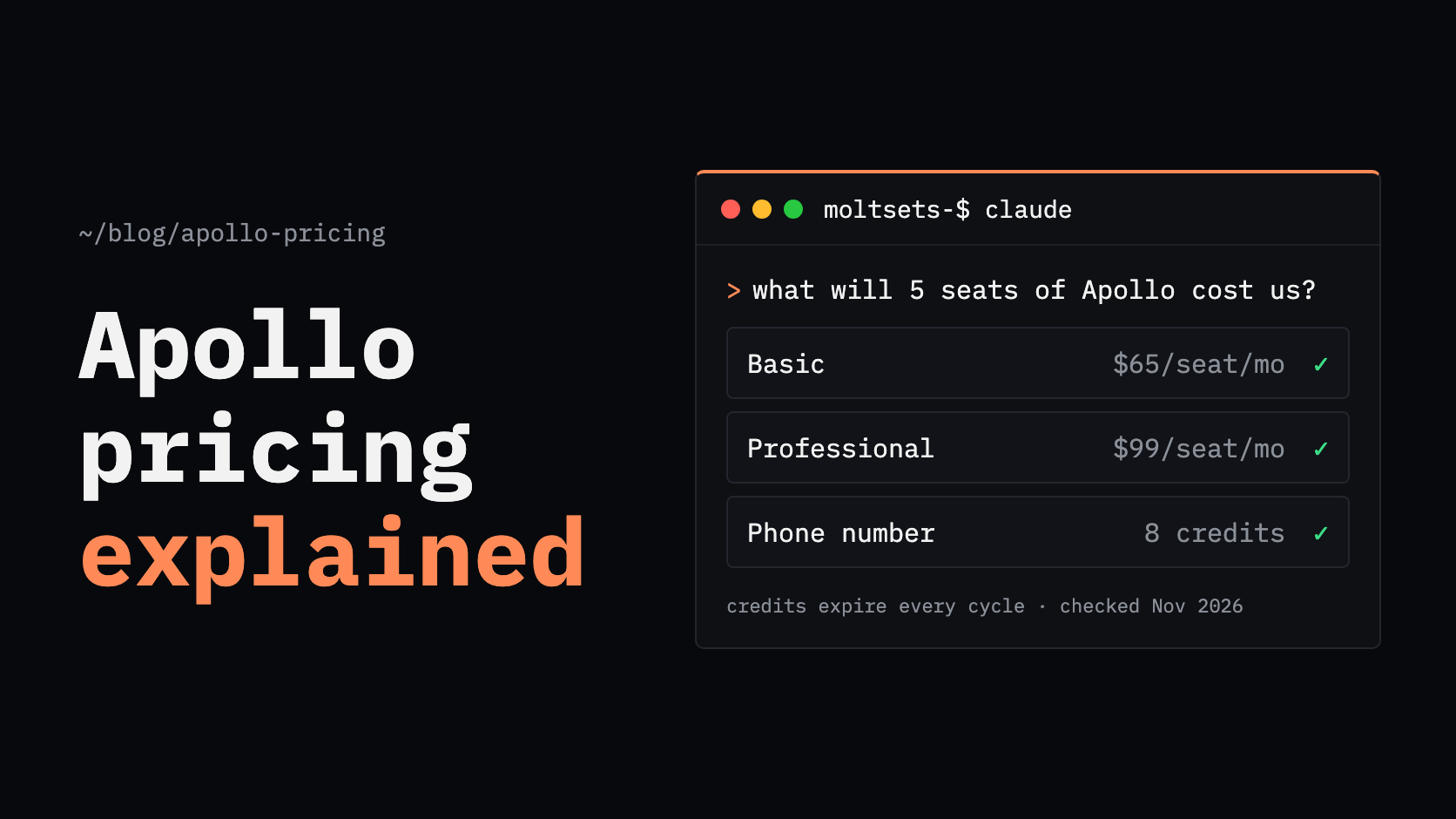
Pricing checked November 2026, on apollo.io/pricing.
TL;DR
Apollo charges per seat, and every seat comes with a monthly pool of credits that you spend on emails, phone numbers, and enrichment. Quick version:
If you want to try Apollo, start on the Free plan. It's $0 with 75 credits per seat a month, enough for about 75 emails or 9 phone numbers.
If you're one rep doing regular outbound, Basic is the entry plan. It's $65 per seat a month on monthly billing ($49 on annual), with 2,500 credits per seat a month.
If you only need verified emails at volume, a flat-rate API like MoltSets can cost less. MoltSets Solo is $27/mo with no per-lookup credits, but it isn't a sales platform.
If you need AI features, call recording, and more credits, Professional is the middle plan. It's $99 per seat a month on monthly billing ($79 on annual), with 4,000 credits per seat a month.
If you're a team of three or more on an annual contract, Organization is the top published plan. It's $119 per seat a month, billed annually, with a three-seat minimum and 6,000 credits per seat a month.
If you mostly reveal phone numbers, budget for 8 credits each. An email costs 1 credit, so phones drain the pool eight times faster.
If you don't use your credits, you lose them. Plan and add-on credits expire at the end of each billing cycle.
Apollo's price depends on how many seats you buy and how you spend credits, so do the math for your own mix before you commit.
If you work in Claude or ChatGPT, connect MoltSets and ask in plain English. Verified results come back in the chat.
How much does Apollo cost?
Apollo costs $0 to $149 per seat a month on its published plans, plus a Custom plan through sales. The price you pay depends on the plan, the number of seats, and whether you bill monthly or annually. Apollo says annual billing saves up to 24%.
Plan | Monthly billing | Annual billing | Credits per seat | Seat minimum |
|---|---|---|---|---|
Free | $0 | $0 | 75 a month (900 a year) | – |
Basic | $65/seat/mo | $49/seat/mo | 2,500 a month (30,000 a year, upfront) | – |
Professional | $99/seat/mo | $79/seat/mo | 4,000 a month (48,000 a year, upfront) | – |
Organization | Annual only ($149 shown on the monthly view) | $119/seat/mo | 6,000 a month (72,000 a year, upfront) | 3 seats |
Custom | Through sales | Through sales | Custom | – |
A few things the table doesn't show:
All seats on an account must be on the same plan. You can't put one power user on Professional and the rest on Basic.
Basic, Professional, and Organization include a 14-day trial. The trial comes with 75 credits.
Add-ons cost extra. Inbound (website visitor ID, routing, forms) is $119 or $639 per team a month, and the Advanced Dialer is $119 per team a month, both billed annually.
Prices exclude tax.
How do Apollo credits work?
Apollo credits are the currency you spend to reveal contact data and run some features. Each seat adds credits to a shared team pool, and different actions cost different amounts.
Action | Credit cost |
|---|---|
1 credit | |
Phone number | 8 credits |
Enrich data | 1–8 credits |
AI research | 1 credit per run |
US dialer | 1 credit per 30 seconds |
International dialer | Varies by region |
How the pool behaves:
Credits are pooled across the team. Five Basic seats give one pool of 12,500 credits a month, not five separate buckets.
Credits are granted upfront. On monthly billing, you get the month's credits on day one. On annual billing, you get the whole year's credits upfront (for example, 30,000 per Basic seat).
Credits don't roll over. Unused credits expire at the end of each billing cycle, including credits you bought as an add-on.
Admins can cap credits per user. Settings → Credit usage shows who spent what.
Apollo's credit system is a common way to price B2B data enrichment. The catch with any per-lookup model is that your bill grows with your list.
How do Apollo seats work?
A seat is one user license, and each one adds credits to the pool. Seats are how Apollo prices both access and data volume, so adding a person and adding credits are often the same purchase.
Seats drive the price. Five Professional seats on monthly billing cost 5 × $99 = $495 a month.
Seats also drive the credits. Those five seats add 5 × 4,000 = 20,000 credits a month to the pool.
Downgrades take effect right away, without a refund. Apollo says it doesn't refund unused time when you remove seats or drop a plan; the lower price applies from the next term.
Annual plans can't be downgraded mid-cycle. To move from annual to monthly, you cancel and wait for the annual term to end.
Is there a cheaper option than Apollo?
If Apollo's per-seat pricing doesn't fit how you work, consider a tool that charges differently. Apollo makes sense when your reps use its sequences, dialer, and CRM every day. If you mainly need verified contact data, you may be paying for seats and credits you don't use. Our comparison of Apollo alternatives covers the main options.
One of them is a flat-rate enrichment API. MoltSets is a B2B data enrichment API from the team behind RB2B and Retention.com:
How it's priced: Free for 1,000 records (one time). MoltSets Solo is $27/mo flat: up to 1,000 enriched records every 5 hours (5,000 a week) and 500 search records every 5 hours (2,500 a week), with no per-lookup credits. Pro ($97), Team ($397), and Max ($997) raise the limits. No seats and no contracts. MoltSets charges per account, not per person: invite your whole team at no extra charge, and everyone shares the plan's limits.
Where it's used: You connect MoltSets to Claude, ChatGPT, or Claude Code and ask in plain English, for example: "Find verified work emails for the VPs of Marketing at these 40 companies." It also runs inside Clay, n8n, or your own code through the API.
What you get: Verified business and personal emails, each with an A–F risk score and a last-validated date, carrier-verified mobile numbers (a metered add-on), and people and company search.
Where it isn't a fit: MoltSets is a B2B data enrichment API, not a sales platform. There's no sequencer, dialer, or CRM, so if your reps live in Apollo's sequences and dialer, Apollo's bundle may be worth the seat price.
What does Apollo cost compared with a flat rate? Worked examples
The real cost of Apollo is the seat price divided by the credits you actually use. These examples use Apollo's and MoltSets' published prices, checked November 2026. The MoltSets column covers emails only, because phone numbers are metered on both tools.
Example 1: one rep, emails only.
Apollo Basic (monthly) | MoltSets Solo | |
|---|---|---|
Price | $65 a month for 2,500 credits | $27 a month, no per-lookup credits |
2,500 emails a month | $65 ÷ 2,500 = $0.026 per email | $27 |
Only 1,200 emails used | 1,300 credits expire, so $65 ÷ 1,200 = about $0.054 per email | $27. Records only count when data comes back |
Example 2: one rep who also reveals phones (Apollo only).
Step | Apollo Basic (monthly) |
|---|---|
200 phone numbers | 200 × 8 credits = 1,600 credits |
Credits left for emails | 2,500 − 1,600 = 900 |
What each phone really costs | 8 × $0.026 = about $0.21 of the plan |
MoltSets charges $0.15 per phone token, used only when a number is found, so phones are an add-on on both tools.
Example 3: a team of five.
Apollo Professional (monthly) | MoltSets | |
|---|---|---|
Seats | 5 × $99 = $495 a month | No seats |
Credits | 5 × 4,000 = 20,000 pooled credits | No per-lookup credits |
Need: 15,000 emails + 1,000 phones | 15,000 + 8,000 = 23,000 credits, 3,000 short | Emails: 15,000 a month fits Solo's 5,000-a-week limit |
Fix | Add a sixth seat: $594 a month (Apollo doesn't publish its add-on credit price) | Solo at $27, or Pro at $97 for headroom, plus phone tokens |
Example 4: the Apollo Organization minimum, for a year.
Apollo Organization (annual) | MoltSets Pro (monthly) | |
|---|---|---|
Price | 3 seats × $119 × 12 = $4,284 a year, upfront | $97 × 12 = $1,164 a year, cancel any time |
What you get | 216,000 credits a year, granted upfront, plus sequences, dialer, and CRM | Up to 75,000 enriched records a week, no sales tools |
The gap is biggest when your team only needs contact data. If your reps use Apollo's sequences and dialer every day, compare the full bundle, not just the data.
What are the hidden costs and gotchas in Apollo pricing?
The biggest gotchas are expiring credits, phones at 8 credits each, and an unpublished add-on credit price. None of these are hidden by Apollo, but they're easy to miss on the plan cards.
Unused credits expire every cycle. That includes add-on credits. Buying a bigger plan "just in case" often means paying for credits you never use.
Add-on credit prices aren't published. You buy them in-app (Settings → Manage Subscription → Customize Credits), and Apollo doesn't list the rate on its pricing page.
Add-on credits renew automatically. They're charged immediately and recur every cycle until you drag the slider back to zero.
Phones cost 8× an email. A mobile-heavy workflow can use up a pool much faster than the email count suggests.
The dialer uses credits too. The US dialer is 1 credit per 30 seconds.
No refunds on downgrades. Removing seats or dropping a plan doesn't refund the rest of your cycle.
Organization is annual-only with three seats. The cheapest way in is 3 seats × $119 × 12 = $4,284 upfront.
Plans are for internal use. Apollo says using its data to power products for your customers needs a separate agreement.
If you keep enriched data in a CRM, remember that contact data goes stale. Re-enriching later uses credits again, so plan for data decay and CRM backfills in your budget.
How can I keep Apollo costs down?
Buy seats for the people who need the platform, and match your credit pool to what you actually reveal each month. Small habits make a large difference to the cost per contact.
Check usage before renewing. Settings → Credit usage shows spend by user, date, and credit type. Size the plan to the last three months, not the busiest week.
Set per-user credit caps. It stops one rep from draining the shared pool.
Reveal phones only where you'll call. Each one is 8 credits.
Filter before you reveal. Use search and filters (which don't reveal contact data) to narrow your ICP list first, then spend credits only on the records you'll contact.
Remove add-on credits after a busy month. They renew automatically otherwise.
Go annual only if you're sure. Annual billing is cheaper per seat, but you can't downgrade mid-cycle.
Track bounces. If a lot of revealed emails bounce, you're paying for data you can't use. See how to measure contact data accuracy.
Frequently asked questions
Apollo costs $0 on Free, $65 per seat on Basic, and $99 per seat on Professional with monthly billing (checked November 2026). Annual billing lowers that to $49 and $79 per seat. Organization is $119 per seat a month, billed annually, with a three-seat minimum.
Apollo credits are pooled across your team and granted at the start of each billing cycle. An email costs 1 credit, a phone number 8 credits, enrichment 1–8 credits, and AI research 1 credit per run. Unused credits expire at the end of the cycle.
No. Apollo credits expire at the end of each billing cycle and don't carry over, and that applies to add-on credits too.
Apollo doesn't publish its add-on credit price. You buy extra credits in-app with a slider under Settings → Manage Subscription → Customize Credits, and they renew each cycle until you remove them.
An Apollo phone number costs 8 credits, compared with 1 credit for an email. On Basic, 2,500 credits buys about 312 phone numbers or 2,500 emails. For other ways to get mobiles, see how to find mobile phone numbers.
Yes. Apollo's Free plan is $0 with no time limit and includes 75 credits per seat a month, 2 sequences, and basic filters.
Yes. Apollo has an MCP server, which is how a tool plugs into Claude, so you can query Apollo data from a Claude chat on your existing plan. Credits are charged the same way.
If you only need verified emails and not sequences or a dialer, a flat-rate enrichment API like MoltSets can cost less. MoltSets Solo is $27/mo flat, with up to 5,000 enriched records a week and no per-lookup credits. Use it to find work emails inside Claude, ChatGPT, Clay, or your own code.
Apollo publishes its seat prices and ZoomInfo doesn't, so you can't compare list prices directly. ZoomInfo prices its main platform through sales, but its self-serve ZoomInfo GTM.AI costs $0.45 to $0.25 per contact. See ZoomInfo alternatives, compared for what each tool publishes.