Pricing checked November 2026, on apollo.io/pricing and moltsets.com/pricing.
TL;DR
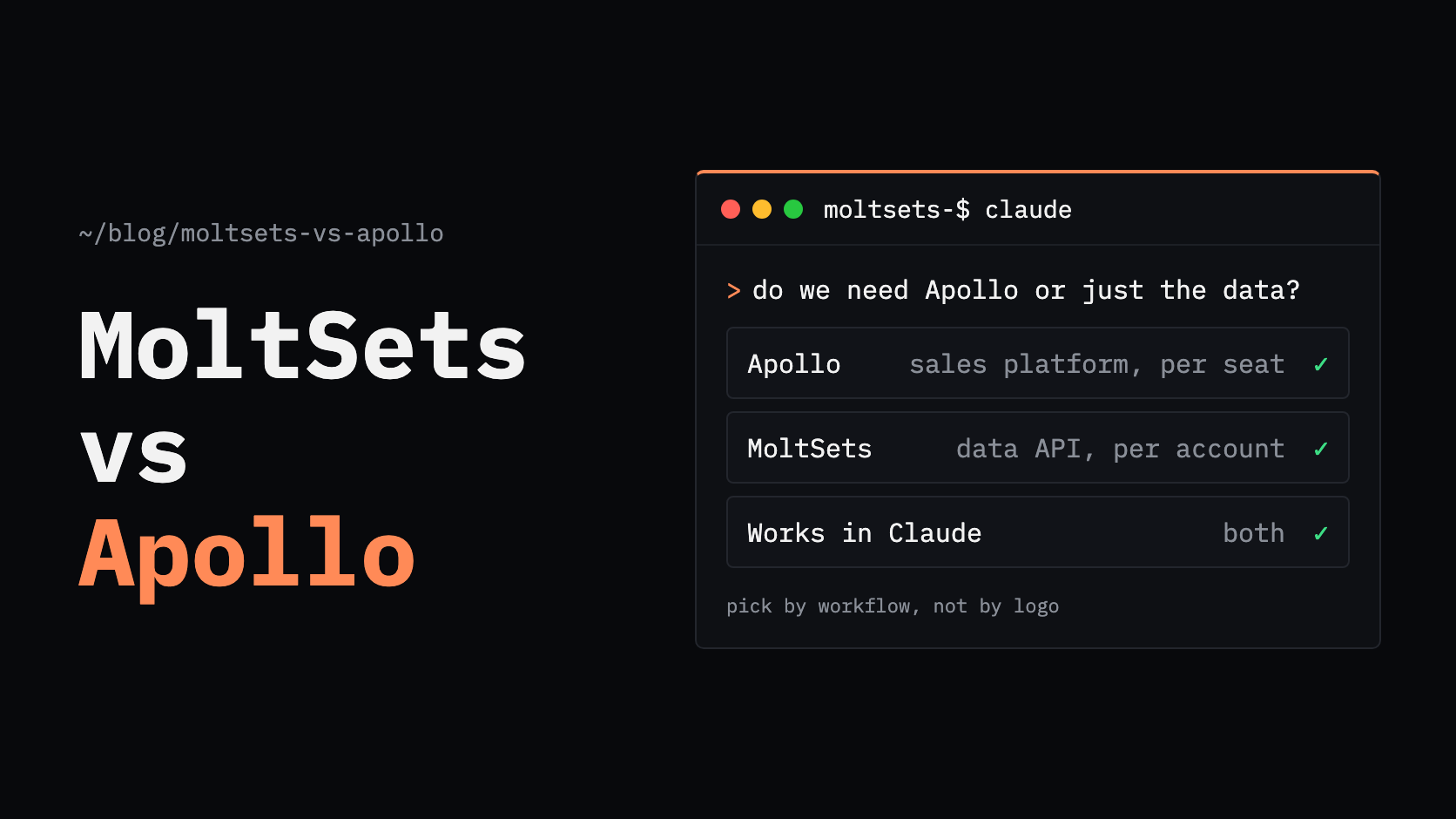
MoltSets and Apollo solve different problems. Apollo is a full sales platform with a contact database, sequences, a dialer, and deal management. MoltSets is a flat-rate data layer: verified emails, mobiles, and people and company data that you pull into Claude, ChatGPT, Clay, or your own code.
Quick version:
If you want verified emails at a flat monthly rate, use MoltSets. Paid plans start at $27/mo with no per-lookup credits, bounded by rate limits and a fair-use policy.
If you want one platform for finding leads, sequencing emails, and calling, use Apollo. Basic is $65 per seat per month on monthly billing and includes unlimited sequences.
If your reps need a dialer, use Apollo. MoltSets doesn't have one.
If you enrich thousands of rows in Clay, Claude Code, or your own code, use MoltSets. Apollo's credits are tied to seats and expire every billing cycle.
If you already pay for Apollo, keep it for outreach and add MoltSets as a data source when credits run short.
If you work in Claude or ChatGPT, connect MoltSets and ask in plain English. Verified results come back in the chat, with no separate app to log into.
No contact data source is 100% accurate. Check the verification status before you send.
What's the difference between MoltSets and Apollo?
Apollo is a sales platform you log into; MoltSets is a contact data API you call from the tools you already use. Apollo bundles its own database with prospecting, email sequences, a dialer, call recording, and deal management, priced per seat with a monthly credit allowance. MoltSets has no app to work in. You connect it to Claude, ChatGPT, Clay, or your code through an MCP server or API and pay a flat monthly rate for enrichment.
That difference drives everything else:
Who uses it. Apollo is built for sales reps and their managers. MoltSets is built for anyone building lists or agent workflows: RevOps, growth engineers, founders, and teams running AI SDRs.
How you pay. Apollo charges per seat: every teammate who uses Apollo needs their own paid seat, and each seat adds credits. MoltSets charges per account, not per person: invite your whole team at no extra charge, and everyone shares the plan's limits. There are no per-email credits.
What you get. Apollo gives you the whole outbound workflow. MoltSets gives you the data and lets you choose the rest of the stack.
MoltSets vs Apollo at a glance
MoltSets | Apollo | |
|---|---|---|
What it is | Contact data enrichment API and MCP server | Sales platform with a built-in database |
Works in Claude and ChatGPT | Yes (MCP server) | Yes (Apollo MCP) |
Pricing model | One flat monthly rate per account; invite your whole team at no extra charge | Per seat: each teammate is a paid seat, with monthly credits |
Entry price (monthly billing) | Free (1,000 lifetime records), then $27/mo | Free (75 credits/mo), then $65/seat/mo |
Email cost | No per-email credits; capped by rate limits | 1 credit per email |
Mobile numbers | Add-on, $0.15 per token, charged only on a match | 8 credits per phone number |
Sequences and dialer | No | Yes |
Unused allowance | Rolling 5-hour and weekly windows | Credits expire each billing cycle |
Best for | Verified data at volume in Claude, Clay, and code | Reps who want data and outreach in one place |
What is Apollo?
Apollo is an all-in-one sales platform that combines a B2B contact database with prospecting, email sequences, a dialer, call recording, and deal management. Apollo says its database covers 240M contacts and 30M companies.
Works in Claude and ChatGPT. Yes. Apollo MCP connects Apollo to Claude, ChatGPT, and Perplexity, and any tool that accepts an MCP server can use https://mcp.apollo.io/mcp. Apollo says any plan qualifies, including Free, and there's no separate MCP fee. Through MCP you can search people and companies, enrich contacts, build sequences, and review replies, and your usage follows your Apollo account limits.
Best for. Sales teams that want one login for finding leads, emailing them, calling them, and tracking deals.
Pricing (monthly billing, checked November 2026):
Free: $0, 75 credits per seat per month.
Basic: $65 per seat per month, 2,500 credits per seat per month.
Professional: $99 per seat per month, 4,000 credits per seat per month.
Organization: annual only, $119 per seat per month billed annually ($149 shown on the monthly view), minimum 3 seats, 72,000 credits per seat per year.
Annual billing saves 24%: Basic is $49 and Professional $79 per seat per month, with the year's credits granted upfront.
Credit costs: email 1 credit, phone number 8 credits, enrichment 1 to 8 credits, US dialer 1 credit per 30 seconds.
Add-on credits are bought in-app with a slider and renew every cycle until you remove them. Apollo doesn't publish the add-on price on its pricing page.
Limitations. Unused credits, including add-on credits, expire at the end of every billing cycle. Credits are pooled across the team, but the only published way to get more is to add seats. Apollo's pricing page also says its standard plans are for internal use only, so using Apollo data to power a product for your own customers needs a separate agreement.
Verdict. Use Apollo if your team wants data, sequences, and a dialer in one platform and will use the seats. Don't use it if you mainly need emails at volume for Clay, an AI agent, or your own code.
What is MoltSets?
MoltSets is a B2B data enrichment API from the team behind RB2B and Retention.com. It returns verified business and personal emails with an A–F risk score and a last-validated date, carrier-verified mobile numbers, LinkedIn data, and people and company search. It's built to be used inside other tools, not as an app you log into. See how MoltSets works.
Works in Claude and ChatGPT. Yes. You connect MoltSets once to claude.ai, Claude Desktop, Claude Code, or ChatGPT, then ask for contacts in plain English. It also works in Cursor and Windsurf, in Clay through the HTTP API, and in your own code through the API.
Best for. Teams that need verified contact data at volume inside Claude, Clay, AI agents, or their own product, at a predictable monthly price.
Pricing (monthly, checked November 2026):
Free: 1,000 enrichment records, one time, no card required.
$27/mo: up to 1,000 enrichment records every 5 hours and 5,000 a week.
$97/mo: up to 15,000 records every 5 hours and 75,000 a week.
$397/mo and $997/mo for larger volumes.
No seat fees, no contracts, no per-email credits. Invite your whole team at no extra charge; everyone shares the plan's limits. Records are only used when a lookup finds something, and misses are free.
Mobile numbers are a paid add-on at $0.15 per phone token, charged only when a number comes back.
Limitations. MoltSets isn't a sales platform. There's no sequencer, dialer, or CRM, so you'll pair it with tools for outreach. Phone numbers are metered, not flat-rate.
Verdict. Use MoltSets if you need verified emails and contact data at volume in Claude, Clay, or code and want a flat monthly bill. Don't use it if you want your data, sequences, and dialer in a single app.How much do verified emails cost on MoltSets vs Apollo?
For emails alone, MoltSets costs $27 to $97 a month at the volumes below, while Apollo's cost grows with seats, from $65 to $1,287 a month on monthly billing. The table uses list prices, monthly billing, and the cheapest plan that covers each volume with included credits.
Apollo doesn't publish its add-on credit price, so adding seats is the only published way to get more credits.
Verified emails a month | MoltSets | Apollo (monthly billing) |
|---|---|---|
1,000 | $0 for the first 1,000 (one time), then $27 | $65 (Basic, 1 seat, 2,500 credits) |
5,000 | $27 (5,000 records a week) | $130 (Basic, 2 seats, 5,000 credits) |
20,000 | $27 if spread across the month, or $97 to run them faster | $495 (Professional, 5 seats, 20,000 credits) |
50,000 | $97 (75,000 records a week) | $1,287 (Professional, 13 seats, 52,000 credits) |
How the Apollo numbers work: one email costs 1 credit. Basic gives 2,500 credits per seat and Professional 4,000. For 20,000 emails, five Professional seats ($495) beat eight Basic seats ($520). For 50,000, thirteen Professional seats ($1,287) just beat twenty Basic seats ($1,300).
Annual billing lowers Apollo's cost by 24%. For 50,000 emails a month, twenty Basic seats at $49 come to $980 a month, paid for a year upfront.
The seats aren't wasted if your team uses Apollo's sequences and dialer. If you only want the data, a flat monthly rate keeps the bill the same whether you enrich 5,000 rows or 50,000. Phone numbers are left out of this comparison because they're metered on both tools.
Can you use Apollo or MoltSets inside Claude or ChatGPT?
Yes, both have MCP servers, which is how a tool plugs into Claude or ChatGPT. Apollo MCP brings Apollo's search, enrichment, and sequences into the chat. MoltSets brings verified contact data into the chat at a flat rate, with no seat to buy.
To use MoltSets in Claude or ChatGPT:
Connect once. Add MoltSets as a custom connector in Claude or ChatGPT, or run one claude mcp add command in Claude Code, and sign in.
Ask in plain English. For example: "Find the Head of RevOps at each of these 30 companies and get their verified work email with the risk score. Return a table."
Get verified results in the chat. Each email comes back with an A–F risk score and its last-validated date, ready to paste into your CRM or sequence.
There's no dashboard and no exporting. For more on agent workflows, see the best enrichment tools for Claude Code and AI agents.
Can you use MoltSets and Apollo together?
Yes, and plenty of teams do: Apollo for outreach, MoltSets for data at volume. Reps keep Apollo for sequences, calls, and deals. RevOps or an agent uses MoltSets to fill gaps, such as backfilling missing emails in the CRM or building a lead list with an API, without spending Apollo credits.
Common splits:
Apollo finds, MoltSets fills. Build the list in Apollo, then run the rows Apollo didn't return an email for through MoltSets.
MoltSets in Clay, Apollo in the sequence. Enrich in a Clay table, then push the contacts to Apollo to sequence. See the best enrichment API for Clay.
One agent, two connectors. Connect both to Claude and let it use MoltSets for data and Apollo for sequencing.
Which should you choose, MoltSets or Apollo?
If you want data, sequences, a dialer, and deal tracking in one login, use Apollo.
If your team makes calls from the same tool it prospects in, use Apollo.
If you need verified emails at volume and want a flat monthly bill, use MoltSets.
If you work in Claude or ChatGPT, connect MoltSets and ask for contacts in plain English.
If you enrich rows in Clay, n8n, or your own code, use MoltSets.
If you're building a product that uses contact data, check Apollo's terms first, because its standard plans are for internal use only.
If you already run outreach in Apollo and keep running out of credits, add MoltSets for enrichment and keep Apollo for sequences.
Frequently asked questions
MoltSets is a good Apollo alternative for the data part of Apollo, not the sales platform part. It returns verified emails, mobiles, and people and company data at a flat monthly rate, but it has no sequencer, dialer, or CRM. If you want to replace Apollo entirely, compare full platforms in our guide to the best Apollo alternatives.
For emails alone, yes. 5,000 verified emails a month cost $27 on MoltSets and $130 on Apollo (two Basic seats on monthly billing). At 50,000 a month, it's $97 on MoltSets and $1,287 on Apollo. Apollo's price also includes sequences, a dialer, and other sales tools, so it's cheaper per seat if your team uses them.
Apollo costs $0 on Free, $65 per seat per month on Basic, and $99 per seat per month on Professional, on monthly billing. Annual billing saves 24% ($49 and $79). Organization is annual only at $119 per seat per month, with a 3-seat minimum. Each plan includes credits: 75, 2,500, and 4,000 per seat per month on Free, Basic, and Professional.
An email costs 1 Apollo credit and a phone number costs 8. Credits are pooled across your team, and unused credits, including add-on credits, expire at the end of each billing cycle. For more on how per-credit pricing adds up, see our breakdown of data enrichment cost.
Yes. Apollo MCP lives at https://mcp.apollo.io/mcp and works with Claude, ChatGPT, Perplexity, and other MCP clients. Apollo says it's available on every plan, including Free, at no extra cost, and it uses the same limits as your Apollo account. MoltSets also has an MCP server, so both work inside Claude.
Yes, once you connect a contact-data tool. Claude has no verified contact data built in. With MoltSets connected, you can ask Claude to find someone's work email or enrich a whole list, and the emails come back in the chat with a risk score. Apollo MCP does the same with Apollo's credits.
No. MoltSets doesn't have a dialer, sequencer, or CRM. It returns contact data, including carrier-verified mobile phone numbers, and you send it to the tools you already use for outreach.
Neither publishes a match rate you can compare directly, so test both on the same list. MoltSets gives every email an A–F risk score and a last-validated date, so you can filter before sending. See how to measure contact data accuracy for a fair way to run the test.
Apollo is the lower-cost, self-serve sales platform, and ZoomInfo is the enterprise data platform. For pure data providers, including APIs that work in Claude and Clay, see the best B2B data enrichment APIs and the best ZoomInfo alternatives.
Yes. Apollo is a native provider in Clay, so teams that already pay for Apollo can use its data in a Clay table. MoltSets also runs in Clay through Clay's HTTP API step. If you're weighing Clay itself, see our guide to Clay alternatives.