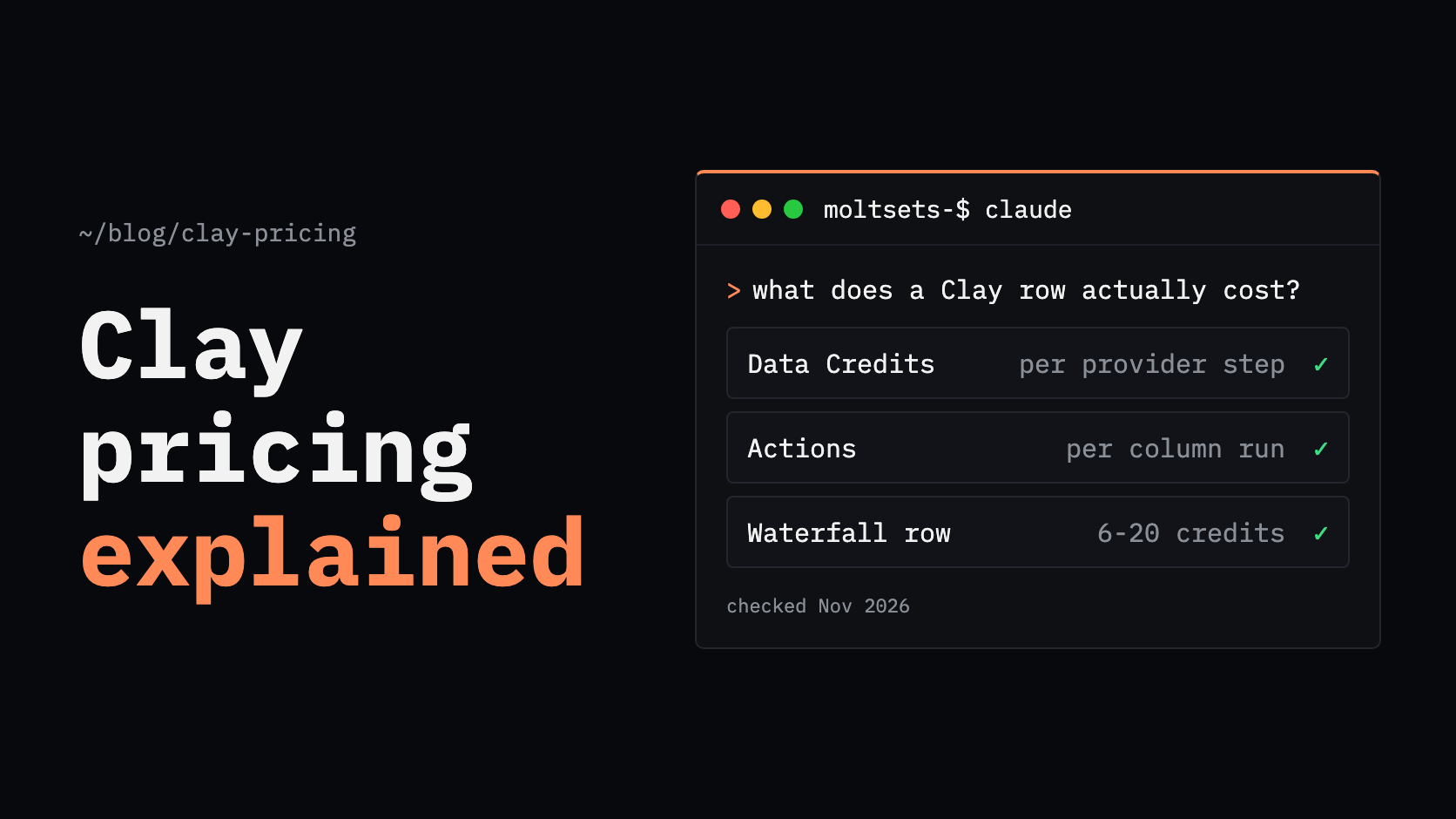
Pricing checked November 2026, on clay.com/pricing and Clay's credits docs.
TL;DR
Clay charges for two things separately: Actions (the platform work) and Data Credits (the data you buy from its 150+ providers). Seats are unlimited on every plan. Quick version:
If you want to try Clay, start on Free. It's $0 with 500 Actions and 100 Data Credits a month, up to 200 rows per table, and no phone enrichment.
If you're a small team starting to automate prospecting, Launch is the entry plan. It's $185/mo on monthly billing ($167/mo on annual) for 15,000 Actions and 2,500 Data Credits a month.
If you want flat-rate emails inside Clay, plug in an enrichment API like MoltSets. MoltSets Solo is $27/mo with no per-lookup credits, and it runs inside Clay rather than replacing it.
If you sync with a CRM and run larger campaigns, Growth is the next plan. It's $495/mo on monthly billing ($446/mo on annual) for 40,000 Actions and 6,000 Data Credits a month.
If you need 100,000+ credits, SSO, or bulk enrichment over 50,000 records, Enterprise is custom.
If you bring your own provider API keys, you skip Data Credits for that step. Each run still uses one Action.
If an enrichment finds nothing, Clay doesn't charge for it. No Data Credits or Actions are used on a no-result.
If you work in Claude or ChatGPT, connect MoltSets and ask in plain English. Verified results come back in the chat.
Clay's bill depends on which providers you pick and how many steps each row runs, so estimate per row before you scale a table.
How much does Clay cost?
Clay costs $0 on Free, from $185/mo on Launch, from $495/mo on Growth (monthly billing), and a custom price on Enterprise. Annual billing saves 10%. Each paid plan's price is the sum of an Actions tier and a Data Credits tier, and you can raise either one.
Plan | Monthly billing | Annual billing | Actions | Data Credits | Seats |
|---|---|---|---|---|---|
Free | $0 | $0 | 500/mo | 100/mo | Unlimited |
Launch | From $185/mo | From $167/mo | From 15,000/mo | From 2,500/mo | Unlimited |
Growth | From $495/mo | From $446/mo | From 40,000/mo | From 6,000/mo | Unlimited |
Enterprise | Custom (annual) | Custom (annual) | Custom | Custom | Unlimited, plus user groups and RBAC |
How the Launch and Growth starting prices break down on monthly billing:
Launch: $60 for 15,000 Actions + $125 for 2,500 Data Credits = $185.
Growth: $205 for 40,000 Actions + $290 for 6,000 Data Credits = $495.
Data Credit tiers (monthly billing, Launch and Growth):
Data Credits a month | Price a month | Price per credit |
|---|---|---|
2,500 (Launch only) | $125 | $0.050 |
6,000 | $290 | about $0.048 |
10,000 | $460 | $0.046 |
20,000 | $880 | $0.044 |
50,000 | $2,125 | $0.0425 |
Actions tiers (monthly billing):
Launch: 15,000 ($60), 40,000 ($150), 60,000 ($200), 100,000 ($290), 200,000 ($540).
Growth: 40,000 ($205), 60,000 ($290), 100,000 ($450), 200,000 ($850).
What else changes by plan: Free has no phone enrichment and caps tables at 200 rows; Launch allows up to 50,000 rows per table; Growth adds CRM auto-sync and enrichment; Enterprise adds bulk enrichment of 50,000+ records at once. Paid plans have a 14-day trial.
How do Clay Actions and Data Credits work?
Actions pay for the work Clay does; Data Credits pay for the data Clay buys for you. Clay splits them so you can see what's platform cost and what's data cost.
Actions:
What uses them: Clay's docs say each record enriched or exported costs 1 Action, whatever the data source. That includes runs that use your own API keys, AI runs, signals, and exports to a CRM or ad audience.
What doesn't: Sourcing lists, CRM and warehouse imports, webhooks, formulas, filters, and CSV export.
What they cost: Under a cent each. On Launch, $60 ÷ 15,000 = $0.004 per Action.
Data Credits:
What uses them: Data bought through Clay's marketplace: emails, phone numbers, company data, and some AI models.
What they cost: From $0.05 each, getting cheaper at higher tiers.
How many per lookup: It depends on the provider and data type. Clay's docs say costs vary from 0.5 to 10+ credits, and a fully enriched record typically costs 6–20 Data Credits. Clay's own example prices finding an email at 0.5 credits and a LinkedIn profile enrichment at 0.5 credits.
AI: About 80% of AI models have a fixed Data Credit cost per task. Token-heavy models are billed on actual tokens and shown with a "~" estimate.
What isn't charged:
No result: If an enrichment returns nothing, Clay doesn't charge Data Credits or Actions.
Your own keys: If you bring your own API key for a provider, that step uses no Data Credits, only one Action per run.
Refunds: If a provider refunds Clay for invalid data, Clay refunds the Data Credits.
This split is one of several ways tools charge for data enrichment. For how Clay's provider waterfall works in practice, see the guide to the best enrichment API for Clay.
What are the hidden costs and gotchas in Clay pricing?
The main gotchas are per-row costs that add up across steps, Actions that don't roll over, and top-ups at a 30% premium. Clay publishes all of this, but it's spread across the plan cards, comparison table, FAQ, and docs.
Every step costs. A row that runs a waterfall, an email finder, a validation, and an AI column can use 6–20 Data Credits plus several Actions.
Actions don't roll over. They reset every billing cycle.
Actions can't be topped up. If you hit the Actions limit, you have to move up an Actions tier.
Data Credit top-ups cost 30% more. Upgrading the tier is cheaper per credit if you'll need the credits again next month.
Rollover has limits. On monthly Launch and Growth plans, unused Data Credits can build up to 2× your monthly amount. On annual plans, 15% of unused credits roll over if you renew at the same or a higher tier.
Stopped runs still cost. Clay's docs say requests already sent still use Data Credits if you stop a run midway.
Automatic top-ups have rules. The minimum top-up is 250 credits, each top-up is capped at $1,000, and there's a $5,000 limit in any rolling 7 days.
Phone enrichment needs a paid plan. Free doesn't include it.
How can I keep Clay costs down?
Cut the number of paid steps per row, and only enrich rows you'll actually use. Clay's own pricing rewards both.
Filter before you enrich. Formulas and filters don't use Actions, so trim your lead list to your ICP before any paid column runs.
Order waterfalls by cost. Put the cheapest provider that's good enough first, so pricier ones only run on misses.
Bring your own keys where you already pay. If you already subscribe to a data provider, a BYOK step skips Data Credits.
Run on a sample first. Test a new table on 50 rows and check the credits used before you run 5,000.
Upgrade instead of topping up. A higher tier avoids the 30% top-up premium.
Check accuracy. Paying less per email doesn't help if they bounce. See how to measure contact data accuracy.
Can I lower my Clay bill without leaving Clay?
Yes. If Clay's per-row credits add up, you don't have to leave Clay: you can swap the email step for a flat-rate API. Clay is a channel, not a competitor: you can run a flat-rate enrichment API inside Clay and keep the workflow you've built. MoltSets is one option. It's a B2B data enrichment API from the team behind RB2B and Retention.com, and it connects to Clay through its HTTP API with your own key.
How it's priced: Free for 1,000 records (one time). MoltSets Solo is $27/mo flat: up to 1,000 enriched records every 5 hours (5,000 a week) and 500 search records every 5 hours (2,500 a week), with no per-lookup credits. Pro ($97) raises the limits. MoltSets charges per account, not per person, so your whole team can use it at no extra charge.
What it does to your Clay bill: Because it's your own key, MoltSets steps use no Clay Data Credits, only one Action per row.
When it pays off: At Clay's 0.5-credit email example ($0.025 per email on Launch), MoltSets' $27 matches the cost of 27 ÷ 0.025 = 1,080 emails a month. Above that, flat-rate is cheaper for that step. Below it, Clay's credits are cheaper.
What you get: Verified business and personal emails with an A–F risk score and a last-validated date, carrier-verified mobile numbers (a metered add-on), people and company search, and reverse email lookup.
Where it isn't a fit: MoltSets is a B2B data enrichment API. It doesn't build tables, run AI columns, or orchestrate 150+ providers like Clay does. It's not a sequencer or CRM either.
You can also skip the table entirely: connect MoltSets to Claude, ChatGPT, or Claude Code and ask in plain English, for example: "Find verified work emails for these 200 LinkedIn profiles and give me a CSV." If you're weighing that route, see the best Clay alternatives.
What does Clay actually cost? Worked examples
The real cost of a Clay table is (Data Credits per row × rows) plus (Actions per row × rows). These examples use Clay's published prices and the per-lookup figures from Clay's own docs, checked November 2026. Where the step is a work email, the MoltSets column shows the same job with MoltSets plugged into Clay. Your provider choices will change the numbers.
Example 1: 1,000 work emails a month, on Launch (monthly). Clay's docs price an email at 0.5 Data Credits.
Clay marketplace email | MoltSets inside Clay | |
|---|---|---|
Data Credits | 1,000 × 0.5 = 500 credits, $25 | 0 |
Actions | 1,000 × $0.004 = $4 | 1,000 × $0.004 = $4 |
Data cost | $25 | $27 (Solo) |
Verdict | Cheaper at this volume | Breaks even at about 1,080 emails |
Example 2: 5,000 work emails a month, on Launch (monthly).
Clay marketplace email | MoltSets inside Clay | |
|---|---|---|
Data Credits | 5,000 × 0.5 = 2,500 credits, all of Launch's $125 tier | 0, so the 2,500 credits stay free for other steps |
Actions | 5,000, inside Launch's 15,000 | 5,000, inside Launch's 15,000 |
Data cost | $125 | $27 (Solo, under its 5,000-a-week limit) |
Example 3: 20,000 work emails a month.
Clay marketplace email | MoltSets inside Clay | |
|---|---|---|
Data Credits | 20,000 × 0.5 = 10,000 credits, the $460 tier | 0 |
Actions | 20,000, so Launch's 40,000 tier ($150) | 20,000, so Launch's 40,000 tier ($150) |
Data cost | $460 | $27 (Solo, close to its 5,000-a-week limit) or $97 (Pro) for headroom |
Example 4: fully enriched records on Launch (Clay only). Clay's docs say a fully enriched record typically costs 6–20 Data Credits.
Credits per record | Records 2,500 credits cover | Credits for 1,000 records | Tier needed |
|---|---|---|---|
6 | About 416 | 6,000 | $290 |
20 | 125 | 20,000 | $880 |
Example 5: running out mid-month on Launch (Clay only).
Option | Credits | Cost | Per credit |
|---|---|---|---|
Top up 1,000 credits (30% premium) | 1,000 | $65 | $0.065 |
Move from the 2,500 to the 6,000 tier | +3,500 | +$165 a month | about $0.047 |
Phone numbers are left out of the MoltSets column, because they're metered on both: Clay charges Data Credits, and MoltSets charges $0.15 per phone token.
Frequently asked questions
Clay costs $0 on Free, from $185/mo on Launch, and from $495/mo on Growth with monthly billing (checked November 2026). Annual billing is 10% less: from $167/mo on Launch and $446/mo on Growth. Enterprise is custom.
Clay Actions pay for the platform work, such as enriching a record, running AI, or exporting to a CRM, and cost under a cent each. Data Credits pay for the data Clay buys from its 150+ providers, from $0.05 each. A paid plan includes both.
In Clay's own example, finding an email costs 0.5 Data Credits per email found, but the cost depends on the provider you choose. Clay's docs say lookups range from 0.5 to 10+ credits. For other ways to find work emails, see our guide.
Clay Data Credits roll over up to 2× your monthly amount on monthly Launch and Growth plans, and 15% of unused credits roll over on annual plans if you renew at the same or a higher tier. Actions never roll over.
No. Clay says that if an enrichment returns no result, you're not charged Data Credits or Actions.
Yes. Every Clay plan, including Free, lets you bring your own API key. Each run uses one Action but no Data Credits.
Yes. MoltSets connects to Clay through its HTTP API with your own key, so lookups use one Clay Action per row and no Data Credits. MoltSets Solo is $27/mo flat, with no per-lookup credits.
It depends on how you work. Clay starts at $185/mo for unlimited seats, while Apollo charges per seat ($65/seat/mo on Basic, monthly billing). Clay is a workflow tool that buys data from many providers; Apollo is a database with sequences and a dialer. For other options, see the best Apollo alternatives, compared.
Yes, on paid plans. Clay's Free plan doesn't include phone number enrichment. Phones cost more Data Credits than emails, depending on the provider. See how to find mobile phone numbers for other options.